 Clausery
Free memorandum of understanding (MOU) template (Word)
A memorandum of understanding for two organisations working together: the purpose, what each side will do, how costs are shared, the term, optional confidentiality, and a clear choice of whether it is legally binding.
No sign-up. Your answers stay in your browser. Who it is for: Businesses, charities, schools and public bodies agreeing a partnership, pilot or joint project before, or instead of, a full contract.
Updated · Word (.docx) · Free to use and adapt
Need more than one? Download all 87 templates as one .zip file.
What is in the memorandum of understanding (MOU)
- Parties and short names
- Purpose of the collaboration
- What each party will do, as two lists
- Shared costs, or each side pays its own
- Start and end dates, and ending early by notice
- Optional confidentiality for a set number of years
- Binding or non-binding, with the binding parts named
- Contact people and governing law
- Signature blocks
Read the full template
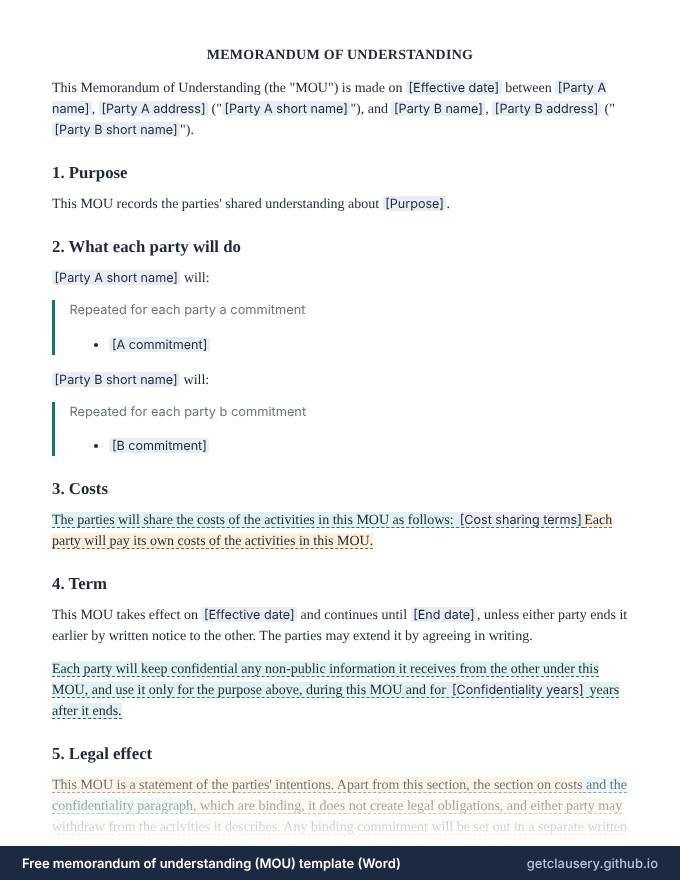
This is the complete wording. [Labels] are filled in from your answers, and highlighted text only appears when it applies; hover over it to see when.
MEMORANDUM OF UNDERSTANDING
This Memorandum of Understanding (the "MOU") is made on [Effective date] between [Party A name], [Party A address] ("[Party A short name]"), and [Party B name], [Party B address] ("[Party B short name]").
1. Purpose
This MOU records the parties' shared understanding about [Purpose].
2. What each party will do
[Party A short name] will:
Repeated for each party a commitment
- [A commitment]
[Party B short name] will:
Repeated for each party b commitment
- [B commitment]
3. Costs
The parties will share the costs of the activities in this MOU as follows: [Cost sharing terms]Each party will pay its own costs of the activities in this MOU.
4. Term
This MOU takes effect on [Effective date] and continues until [End date], unless either party ends it earlier by written notice to the other. The parties may extend it by agreeing in writing.
Each party will keep confidential any non-public information it receives from the other under this MOU, and use it only for the purpose above, during this MOU and for [Confidentiality years] years after it ends.
5. Legal effect
This MOU is a statement of the parties' intentions. Apart from this section, the section on costs and the confidentiality paragraph, which are binding, it does not create legal obligations, and either party may withdraw from the activities it describes. Any binding commitment will be set out in a separate written agreement signed by both parties.The parties intend this MOU to be a legally binding agreement between them.
6. Contacts
[Party A short name]: [Party A contact name], [Party A contact email]. [Party B short name]: [Party B contact name], [Party B contact email].
7. Governing law
This MOU is governed by the laws of [Governing law].
Signed for [Party A name]: ____________________________ [Party A signatory]
Signed for [Party B name]: ____________________________ [Party B signatory]
The questions you answer
Clausery turns the template into a short questionnaire. Optional parts only appear when they apply.
| Question | Type | Asked when |
|---|---|---|
| Effective date | Date | Always |
| Party A name | Short text | Always |
| Party A address | Long text | Always |
| Party A short name | Short text | Always |
| Party B name | Short text | Always |
| Party B address | Long text | Always |
| Party B short name | Short text | Always |
| Purpose | Long text | Always |
| Party A commitments For each item: A commitment | Repeating group | Always |
| Party B commitments For each item: B commitment | Repeating group | Always |
| Has shared costs | Yes / no | Always |
| Cost sharing terms | Long text | If “Has shared costs” is yes |
| End date | Date | Always |
| Include confidentiality | Yes / no | Always |
| Confidentiality years | Number | If “Include confidentiality” is yes |
| Is binding | Yes / no | Always |
| Party A contact name | Short text | Always |
| Party A contact email | Always | |
| Party B contact name | Short text | Always |
| Party B contact email | Always | |
| Governing law | Short text | Always |
| Party A signatory | Short text | Always |
| Party B signatory | Short text | Always |
How to use it
Open it
Click Fill it in now. The template opens in Clausery with its questionnaire ready.
Answer the questions
Work through the sections. Drafts save as you type, on your device.
Download the document
Get a finished Word file with your formatting intact, or print it to PDF.
Prefer to start from your own wording? Download the Word file, edit it, keep the {tags}, and upload it to Clausery. See the template syntax.
Questions
Is an MOU legally binding?
It depends on the wording and how the parties act, not on the title. This template lets you choose: non-binding apart from named clauses such as confidentiality, or binding. Read the guide on whether an MOU is binding before you sign.
What is the difference between an MOU and a contract?
A contract creates obligations the courts will enforce. An MOU usually records shared intentions and a plan, often before a contract is negotiated, though a detailed MOU that says it is binding can be a contract.
Is it really free?
Yes. The download is free, and filling it in with the Clausery app is free too, with unlimited documents. Library templates never count towards a plan limit, and no account or card is needed.
Is my information uploaded anywhere?
No. Clausery runs entirely in your browser. Your answers and the finished document are created and stored on your own device.
Is this legal advice?
No. These are general samples. Laws differ between countries and states, so have the wording reviewed for your situation before you rely on it.
Clauses in this template, explained
Guide: Is an MOU legally binding? How it differs from a contract
Related templates
All 87 free templates
Business agreements
Freelance contracts
- Web design contract
- Graphic design contract
- Photography contract
- Social media management contract
- Freelance writing contract
- Video production contract
- Virtual assistant agreement
- Event planning contract
- Personal training agreement
- Tutoring agreement
- Retainer agreement
- Photo and model release
- Cleaning services contract
- Nanny contract
- Catering contract
- Change order form
- Pet sitting agreement
- Coaching agreement
Loans and getting paid
Landlords and tenants
- Rental application
- Rent receipt
- Lease renewal letter
- Pet addendum
- Residential lease agreement
- Sublease agreement
- Move-in and move-out checklist
- Late rent notice
- Notice to vacate (tenant)
- Rent increase letter
- Security deposit return letter
- Roommate agreement
- Lease termination agreement
- Room rental agreement
- Rent payment plan agreement
- Landlord reference letter
NDAs, letters and sales
HR letters
- Employment agreement
- Employee warning letter
- Promotion letter
- Offer letter
- Employment verification letter
- Termination letter
- Reference letter
- Salary increase letter
- Internship offer letter
- Resignation letter
- Two weeks notice letter
- Severance agreement
- Job description
- Performance improvement plan
- Remote work agreement
This template is a general sample and not legal advice. Laws vary by jurisdiction; have it reviewed before use.