 Clausery
Free consignment agreement template (Word)
A consignment agreement between an owner and a shop, gallery or reseller: the items and their minimum prices, where they are sold, the commission, when the owner is paid, how long the consignment runs, what happens to unsold items, and who bears the risk of loss.
No sign-up. Your answers stay in your browser. Who it is for: Artists, makers and sellers placing goods in a store or gallery, and consignment shops that want consistent terms with every consignor.
Updated · Word (.docx) · Free to use and adapt
Need more than one? Download all 87 templates as one .zip file.
What is in the consignment agreement
- Consignor and consignee
- Item list with minimum prices; ownership until sold
- Where items are sold, with optional online sales
- Optional discounts after a set time
- Commission, payout timing and statements
- Consignment period and collecting unsold items
- Care of items and risk of loss or insurance
- Ending early
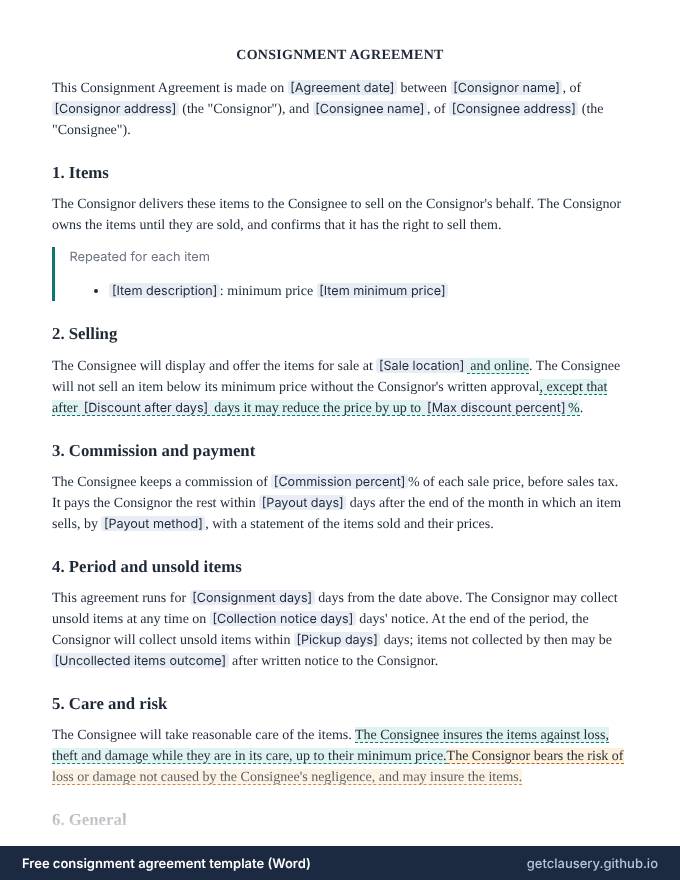
Read the full template
This is the complete wording. [Labels] are filled in from your answers, and highlighted text only appears when it applies; hover over it to see when.
CONSIGNMENT AGREEMENT
This Consignment Agreement is made on [Agreement date] between [Consignor name], of [Consignor address] (the "Consignor"), and [Consignee name], of [Consignee address] (the "Consignee").
1. Items
The Consignor delivers these items to the Consignee to sell on the Consignor's behalf. The Consignor owns the items until they are sold, and confirms that it has the right to sell them.
Repeated for each item
- [Item description]: minimum price [Item minimum price]
2. Selling
The Consignee will display and offer the items for sale at [Sale location] and online. The Consignee will not sell an item below its minimum price without the Consignor's written approval, except that after [Discount after days] days it may reduce the price by up to [Max discount percent]%.
3. Commission and payment
The Consignee keeps a commission of [Commission percent]% of each sale price, before sales tax. It pays the Consignor the rest within [Payout days] days after the end of the month in which an item sells, by [Payout method], with a statement of the items sold and their prices.
4. Period and unsold items
This agreement runs for [Consignment days] days from the date above. The Consignor may collect unsold items at any time on [Collection notice days] days' notice. At the end of the period, the Consignor will collect unsold items within [Pickup days] days; items not collected by then may be [Uncollected items outcome] after written notice to the Consignor.
5. Care and risk
The Consignee will take reasonable care of the items. The Consignee insures the items against loss, theft and damage while they are in its care, up to their minimum price.The Consignor bears the risk of loss or damage not caused by the Consignee's negligence, and may insure the items.
6. General
Either party may end this agreement by written notice, after which the Consignor collects unsold items and the Consignee pays for items already sold. This agreement is governed by the laws of [Governing law].
Consignor: ____________________________ Date: ______________
Consignee: ____________________________ Date: ______________
The questions you answer
Clausery turns the template into a short questionnaire. Optional parts only appear when they apply.
| Question | Type | Asked when |
|---|---|---|
| Agreement date | Date | Always |
| Consignor name | Short text | Always |
| Consignor address | Long text | Always |
| Consignee name | Short text | Always |
| Consignee address | Long text | Always |
| Items For each item: Item description, Item minimum price | Repeating group | Always |
| Sale location | Short text | Always |
| Allow online sales | Yes / no | Always |
| Allow discounts | Yes / no | Always |
| Discount after days | Number | If “Allow discounts” is yes |
| Max discount percent | Number | If “Allow discounts” is yes |
| Commission percent | Number | Always |
| Payout days | Number | Always |
| Payout method | Short text | Always |
| Consignment days | Number | Always |
| Collection notice days | Number | Always |
| Pickup days | Number | Always |
| Uncollected items outcome | Short text | Always |
| Consignee insures | Yes / no | Always |
| Governing law | Short text | Always |
How to use it
Open it
Click Fill it in now. The template opens in Clausery with its questionnaire ready.
Answer the questions
Work through the sections. Drafts save as you type, on your device.
Download the document
Get a finished Word file with your formatting intact, or print it to PDF.
Prefer to start from your own wording? Download the Word file, edit it, keep the {tags}, and upload it to Clausery. See the template syntax.
Questions
What is a typical consignment commission?
It varies by trade: often 20% to 40% for clothing and furniture shops and 40% to 50% for galleries. The agreement should say whether it is calculated before or after tax and discounts.
Who owns consigned goods?
The consignor owns them until they are sold. The consignee sells them on the consignor's behalf and keeps a commission.
What happens to items that do not sell?
The consignor collects them at the end of the period. Say what happens to items left behind, such as donation, after written notice.
Is it really free?
Yes. The download is free, and filling it in with the Clausery app is free too, with unlimited documents. Library templates never count towards a plan limit, and no account or card is needed.
Is my information uploaded anywhere?
No. Clausery runs entirely in your browser. Your answers and the finished document are created and stored on your own device.
Is this legal advice?
No. These are general samples. Laws differ between countries and states, so have the wording reviewed for your situation before you rely on it.
Guide: How does consignment work? Commission, payouts and risk
Free tool: Sales commission calculator: the shop's cut and your payout
Related templates
All 87 free templates
Business agreements
- Independent contractor agreement
- Statement of work
- Consulting agreement
- Service agreement
- Subcontractor agreement
- Memorandum of understanding (MOU)
- Letter of intent (business purchase)
- Partnership agreement
- Sales commission agreement
- Price quote
- Purchase order
- Equipment rental agreement
- Meeting minutes
- Board resolution
Freelance contracts
- Web design contract
- Graphic design contract
- Photography contract
- Social media management contract
- Freelance writing contract
- Video production contract
- Virtual assistant agreement
- Event planning contract
- Personal training agreement
- Tutoring agreement
- Retainer agreement
- Photo and model release
- Cleaning services contract
- Nanny contract
- Catering contract
- Change order form
- Pet sitting agreement
- Coaching agreement
Loans and getting paid
Landlords and tenants
- Rental application
- Rent receipt
- Lease renewal letter
- Pet addendum
- Residential lease agreement
- Sublease agreement
- Move-in and move-out checklist
- Late rent notice
- Notice to vacate (tenant)
- Rent increase letter
- Security deposit return letter
- Roommate agreement
- Lease termination agreement
- Room rental agreement
- Rent payment plan agreement
- Landlord reference letter
NDAs, letters and sales
HR letters
- Employment agreement
- Employee warning letter
- Promotion letter
- Offer letter
- Employment verification letter
- Termination letter
- Reference letter
- Salary increase letter
- Internship offer letter
- Resignation letter
- Two weeks notice letter
- Severance agreement
- Job description
- Performance improvement plan
- Remote work agreement
This template is a general sample and not legal advice. Laws vary by jurisdiction; have it reviewed before use.