 Clausery
Free employee NDA template (Word)
A confidentiality agreement for employees: what counts as confidential, how long it lasts after they leave, returning company property, and the notices US law expects, with no non-compete.
No sign-up. Your answers stay in your browser. Who it is for: Small businesses and HR teams hiring people who will see customer lists, pricing, code or plans.
Updated · Word (.docx) · Free to use and adapt
Need more than one? Download all 87 templates as one .zip file.
What is in the employee NDA
- Company, employee, job title and optional start date
- Definition of confidential information, with optional specific examples and standard exclusions
- Duties during and after employment
- How many years confidentiality lasts after employment ends, with trade secrets protected for longer
- Return of property and deletion from personal devices, with optional written confirmation
- Protected disclosures to regulators, and for US employers the NLRA wording and the Defend Trade Secrets Act notice
- No non-compete: the employee is free to work elsewhere after leaving
- Remedies, severability, governing law and signatures
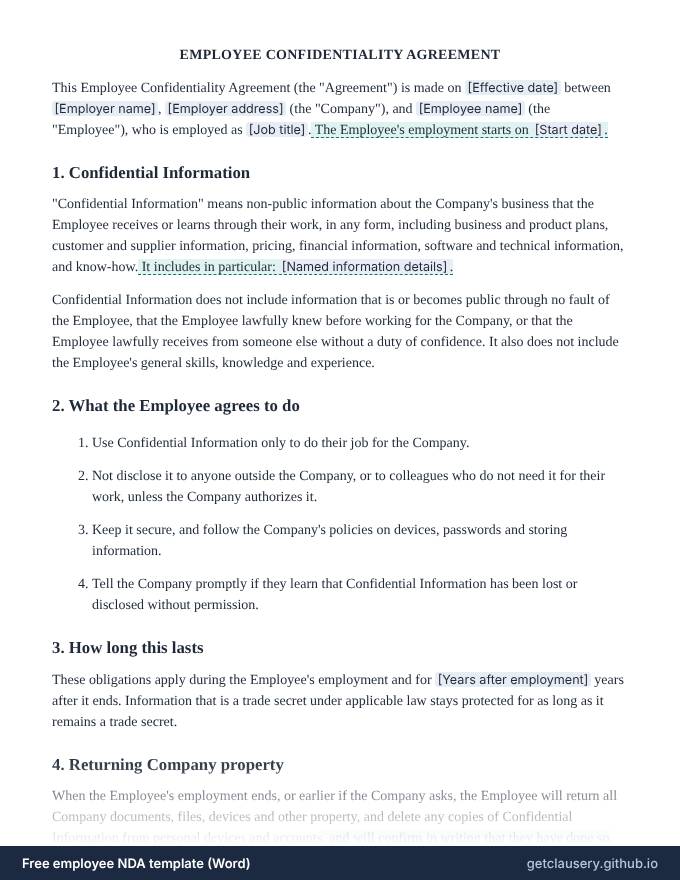
Read the full template
This is the complete wording. [Labels] are filled in from your answers, and highlighted text only appears when it applies; hover over it to see when.
EMPLOYEE CONFIDENTIALITY AGREEMENT
This Employee Confidentiality Agreement (the "Agreement") is made on [Effective date] between [Employer name], [Employer address] (the "Company"), and [Employee name] (the "Employee"), who is employed as [Job title]. The Employee's employment starts on [Start date].
1. Confidential Information
"Confidential Information" means non-public information about the Company's business that the Employee receives or learns through their work, in any form, including business and product plans, customer and supplier information, pricing, financial information, software and technical information, and know-how. It includes in particular: [Named information details].
Confidential Information does not include information that is or becomes public through no fault of the Employee, that the Employee lawfully knew before working for the Company, or that the Employee lawfully receives from someone else without a duty of confidence. It also does not include the Employee's general skills, knowledge and experience.
2. What the Employee agrees to do
- Use Confidential Information only to do their job for the Company.
- Not disclose it to anyone outside the Company, or to colleagues who do not need it for their work, unless the Company authorizes it.
- Keep it secure, and follow the Company's policies on devices, passwords and storing information.
- Tell the Company promptly if they learn that Confidential Information has been lost or disclosed without permission.
3. How long this lasts
These obligations apply during the Employee's employment and for [Years after employment] years after it ends. Information that is a trade secret under applicable law stays protected for as long as it remains a trade secret.
4. Returning Company property
When the Employee's employment ends, or earlier if the Company asks, the Employee will return all Company documents, files, devices and other property, and delete any copies of Confidential Information from personal devices and accounts, and will confirm in writing that they have done so.
5. What this Agreement does not restrict
Nothing in this Agreement prevents the Employee from reporting a possible violation of law to a government agency or regulator, taking part in an investigation, giving truthful evidence, or disclosing information where the law protects the right to do so, including information about harassment, discrimination or other unlawful conduct at work. The Employee does not need the Company's permission to do any of these things. This includes discussing wages, hours and other terms and conditions of employment, as protected by the National Labor Relations Act.
Notice under the Defend Trade Secrets Act (18 U.S.C. § 1833(b)): an individual will not be held criminally or civilly liable under any federal or state trade secret law for disclosing a trade secret (a) in confidence to a federal, state or local government official, directly or indirectly, or to an attorney, solely for the purpose of reporting or investigating a suspected violation of law; or (b) in a complaint or other document filed in a lawsuit or other proceeding, if the filing is made under seal. An individual who files a lawsuit for retaliation for reporting a suspected violation of law may disclose the trade secret to their attorney and use it in the court proceeding, if they file any document containing the trade secret under seal and do not disclose it except under a court order.
This Agreement does not stop the Employee from working for anyone else after leaving the Company. It only protects Confidential Information.
6. Remedies
The Employee understands that a breach of this Agreement could cause the Company harm that money alone cannot put right, so the Company may ask a court for an order to stop a breach, as well as any other remedy the law allows.
7. General
This Agreement does not create employment for any fixed period or change the other terms of the Employee's employment. If any part of it cannot be enforced, the rest still applies. It is governed by the laws of [Governing law].
Signatures
[Employer name]
By: ____________________________
Name and title: [Company signatory] Date: ______________
Employee: ____________________________ [Employee name] Date: ______________
The questions you answer
Clausery turns the template into a short questionnaire. Optional parts only appear when they apply.
| Question | Type | Asked when |
|---|---|---|
| Effective date | Date | Always |
| Employer name | Short text | Always |
| Employer address | Long text | Always |
| Employee name | Short text | Always |
| Job title | Short text | Always |
| Is new hire | Yes / no | Always |
| Start date | Date | If “Is new hire” is yes |
| Has named information | Yes / no | Always |
| Named information details | Long text | If “Has named information” is yes |
| Years after employment | Number | Always |
| Certify return | Yes / no | Always |
| Is us employer | Yes / no | Always |
| Governing law | Short text | Always |
| Company signatory | Short text | Always |
How to use it
Open it
Click Fill it in now. The template opens in Clausery with its questionnaire ready.
Answer the questions
Work through the sections. Drafts save as you type, on your device.
Download the document
Get a finished Word file with your formatting intact, or print it to PDF.
Prefer to start from your own wording? Download the Word file, edit it, keep the {tags}, and upload it to Clausery. See the template syntax.
Questions
Why does it mention the Defend Trade Secrets Act?
US employers are expected to give employees and contractors notice of the whistleblower immunity in 18 U.S.C. § 1833(b) in any agreement about confidential information. Without it, an employer cannot recover exemplary damages or attorney fees under that Act from the employee. Tick the US employer box to include it.
Can an NDA stop employees reporting harassment or discussing pay?
No. An agreement cannot stop people reporting possible violations of law to a government agency. In the US, the Speak Out Act makes non-disclosure clauses signed before a dispute unenforceable for sexual harassment and assault claims, and the National Labor Relations Act protects most employees who discuss pay and working conditions. This template says so plainly.
Does this include a non-compete?
No. It only protects confidential information. Non-competes are banned or limited in several states and countries, so get local advice if you need one.
Is it really free?
Yes. The download is free, and filling it in with the Clausery app is free too, with unlimited documents. Library templates never count towards a plan limit, and no account or card is needed.
Is my information uploaded anywhere?
No. Clausery runs entirely in your browser. Your answers and the finished document are created and stored on your own device.
Is this legal advice?
No. These are general samples. Laws differ between countries and states, so have the wording reviewed for your situation before you rely on it.
Clauses in this template, explained
Guide: How long should an NDA last? Typical terms explained
All NDA templates: which NDA do you need?
Related templates
All 87 free templates
Business agreements
- Independent contractor agreement
- Statement of work
- Consulting agreement
- Service agreement
- Subcontractor agreement
- Memorandum of understanding (MOU)
- Letter of intent (business purchase)
- Partnership agreement
- Sales commission agreement
- Price quote
- Purchase order
- Equipment rental agreement
- Meeting minutes
- Board resolution
- Consignment agreement
Freelance contracts
- Web design contract
- Graphic design contract
- Photography contract
- Social media management contract
- Freelance writing contract
- Video production contract
- Virtual assistant agreement
- Event planning contract
- Personal training agreement
- Tutoring agreement
- Retainer agreement
- Photo and model release
- Cleaning services contract
- Nanny contract
- Catering contract
- Change order form
- Pet sitting agreement
- Coaching agreement
Loans and getting paid
Landlords and tenants
- Rental application
- Rent receipt
- Lease renewal letter
- Pet addendum
- Residential lease agreement
- Sublease agreement
- Move-in and move-out checklist
- Late rent notice
- Notice to vacate (tenant)
- Rent increase letter
- Security deposit return letter
- Roommate agreement
- Lease termination agreement
- Room rental agreement
- Rent payment plan agreement
- Landlord reference letter
NDAs, letters and sales
HR letters
- Employment agreement
- Employee warning letter
- Promotion letter
- Offer letter
- Employment verification letter
- Termination letter
- Reference letter
- Salary increase letter
- Internship offer letter
- Resignation letter
- Two weeks notice letter
- Severance agreement
- Job description
- Performance improvement plan
- Remote work agreement
This template is a general sample and not legal advice. Laws vary by jurisdiction; have it reviewed before use.